
Conduct engineers have started whispering to our laptops, replacing typing with dictation using speech-to-text AI models. The obvious story is speed but it isn’t the important one.
What changed at Conduct
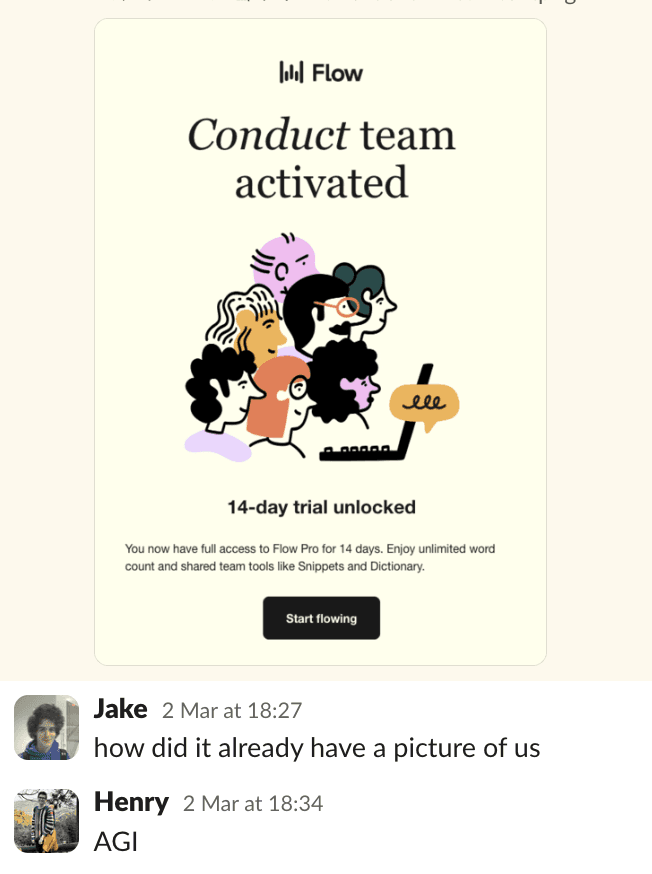
In the New Year, our CTO, Henry, spent many days talking in a phone booth. We prepared for an important announcement, which eventually came through Slack.

Whispering is the scalable replacement for a phone booth if you want to talk to AI agents all day. Admittedly, it’s very funny at first. You are next to a colleague intensely whispering and your instincts can’t tell if they’re talking to you or about you. However five months on, every developer has a microphone at their desk for dictating instructions to coding agents. In my view, it’s a strictly better mode of working.
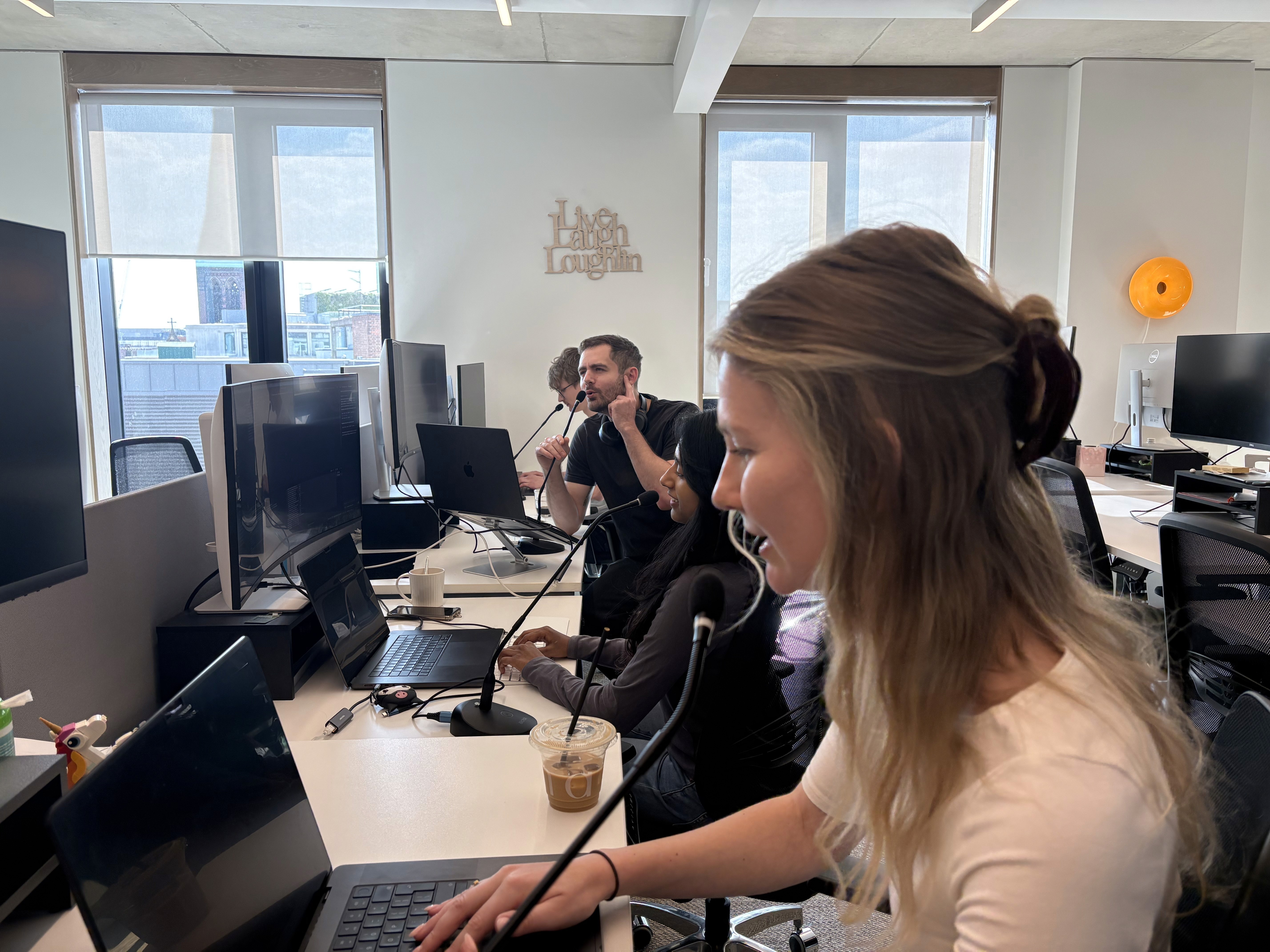
Conduct engineers whispering on the job, using WisprFlow with the recommended BOYA Gooseneck Microphones.
Why this is not about speed
My score on typingtest.com varies with the wind, but for this blog I managed only ~60 wpm at 87% accuracy (the iPad generation). Extrapolating, whispering at 165 wpm might have saved me eight hours across 49,000 words so far, a nice ROI.
However, what I’ve noticed at Conduct, is that whispering to agents embraces a larger shift in what it means to be an effective software engineer.
The Quiet Commander
When coding before LLMs, I spent ~20% of my time making decisions and 80% implementing their outcomes. That ratio is now closer to 90:10. I make choices on solution design, architecture and abstractions, and Ken implements the details.
The role is now to be the key decision-maker for a team of capable, committed agents. Consider other instances of this abstraction: a CEO aligning a room, a director calling scenes, a commander issuing orders—decisions which are most often shared through spoken direction.
With a microphone at my desk, I feel part of the same class of operators. My workspace actually starts to resemble a control room, optimised for giving direction and monitoring outcomes rather than single-focus tasks.
You don’t need to speak directions out loud for them to be effective. But using voice changes your posture. It nudges you to step into the role of decision-maker more deliberately. And that shift matters more than the interface itself.
Communication feeds collaboration
What separates good software engineers from great ones is their ability to collaborate. We care about that a lot at Conduct.
It’s a hard skill, because you have to articulate an approach clearly whilst trying to process the technical complexity in your own mind. Communicating intent to an agent requires the same skill, and actually to a stricter standard, because Ken’s interpretation of what I mean is less forgiving than my colleagues’.
By verbally talking to agents, I train the muscle which organises my thoughts on first attempt without ambiguity, assumption or omission. This is a fast way to become a real asset to any engineering team.
“Do very well, and you’ll be made of gold”
Admittedly, the office now sounds like we are all perpetually scared of a librarian who doesn't exist. This is more humorous than problematic, but there are real limitations to whispering.
Many whisper-to-text AI providers claim “British English” support, a bold promise in a country where the accent changes every ten miles. At Conduct, we also love that our team brings together a wide spread of nationalities: Romanian, Australian, Swedish, German and more. Ekanshi recently joined us from India and has had a more unpredictable experience with whispering.
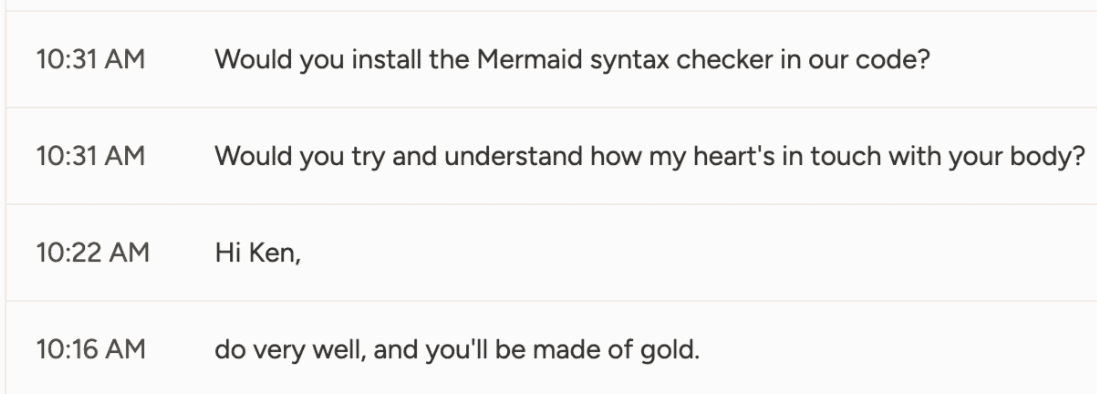
Extract from Ekanshi’s WisprFlow transcription log.
Glad to say, this is not her intended relationship with Ken. We have also noticed that whispering in German results in sporadic and unpredictable translation to English.
This unreliability matters more in some contexts than others. When coding, agents can often infer intent from imperfect input. For business emails, the margin for error is low. The practical takeaway is that voice works better when chained together with another layer of LLM translation, from raw dictation to final output.
This is likely temporary, and dictation quality will improve. In the meantime, there’s a clear opportunity for the teams building these tools. For Conduct to remain whispering champions, we’d love to see what more can be done with accent recognition. As Ekanshi put it, “do very well, and you’ll be made of gold”.
Conclusion
Where the limitations aren’t prohibitive, software engineers should adopt voice as a primary interface for talking to coding agents. Use it to step into the role of decision-maker, and to sharpen your ability to communicate technical intent. You’ll likely become a better engineer as a result, and faster.


